
Quran Academy Software Implementation Checklist: From Records to Go-Live
Use this practical checklist to prepare academy records, configure workflows, test access, train staff and make an evidence-based decision before going live.
A practical system for recording Quran lessons, Surah and Ayah ranges, recitation quality, Tajweed focus, revision evidence, teacher feedback and clear parent updates.
Updated

A Quran academy can track learner progress reliably by recording one structured entry after each lesson and reviewing the history over time. Every entry should answer three questions: what exact portion or topic was covered, how the learner performed against the academy's rubric, and what should happen next. Page counts alone cannot answer all three.
A useful system supports the teacher's judgment; it does not replace it. The academy must define its curriculum, assessment language and revision method with qualified Quran educators, then make the record simple enough for teachers to complete consistently.
Progress is not identical across Qaida, Tilawah, Tajweed, Hifdh, Arabic and Islamic Studies. Before choosing fields or reports, write the learning objective for each programme and the evidence a teacher should observe.
A beginning reader may be progressing through letter recognition, joining, vowel signs, fluency and accurate decoding. The most useful record may be the lesson or page reached, the skill practised, recurring reading errors and the next exercise. Counting Surahs would not describe this work accurately.
For recitation, record the Quran location alongside observable quality: fluency, application of rules, articulation concerns and the teacher's next instruction. The location shows where the lesson happened; it does not prove that the recitation was secure.
For memorisation, distinguish the portion presented from the quality of recall and the revision expected next. An academy may use new lesson, recent revision and older revision, or a named method such as Sabaq, Sabqi and Manzil. The terminology should follow the academy's approved teaching method rather than a software default.
For other subjects, record the topic, activity or assessment, a compact performance judgment, teacher feedback and the next learning task. The reporting principles remain the same even though Surah and Ayah fields do not apply.
A reliable Quran progress record combines position, quality and continuity. If one layer is missing, the academy sees only part of the learner's journey.
Position identifies the exact work: Surah and Ayah range, page, Juz, Qaida lesson, Arabic topic or Islamic Studies topic. Use the reference system your teachers and families understand, and avoid mixing incompatible references without explanation.
Quality records the teacher's assessment against an agreed rubric. It may include a rating, significant Tajweed or articulation concerns, fluency, recall or comprehension. The label must have a shared meaning across teachers.
Continuity connects the lesson to what happens next. It includes teacher feedback, assigned revision, the next target, follow-up needs and the historical record. This layer prevents a learner from restarting the conversation at every lesson or teacher change.
| Layer | Question | Example evidence | Risk if missing |
| Position | What was covered? | Surah Al-Mulk, Ayahs 1-10 | The next teacher cannot locate the work |
| Quality | How was it performed? | Good; Madd and Makhraj need attention | Distance is mistaken for mastery |
| Continuity | What happens next? | Revise the range and recheck next lesson | Feedback does not change the plan |
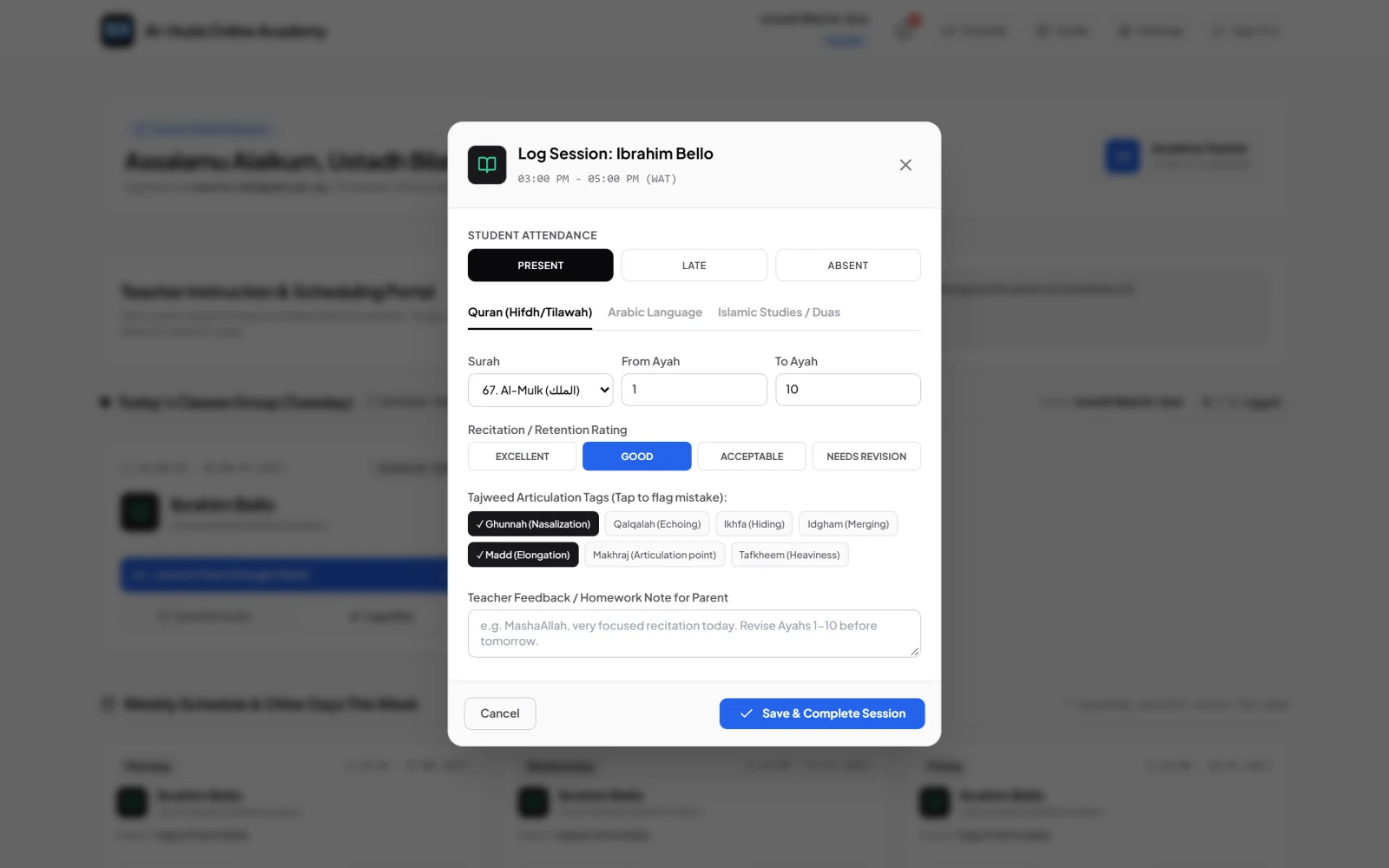
The record should be detailed enough for continuity but short enough to complete immediately after teaching. Start with required fields that affect the next lesson. Add optional fields only when the academy has a clear use for them.
Do not require teachers to fill every possible field after every lesson. A record crowded with unused checkboxes encourages rushed or invented entries. Review which fields actually support teaching decisions, parent communication or academic supervision.
A label such as excellent, good, acceptable or needs revision is useful only when teachers share its meaning. Write a short descriptor for each level and test it against the same fictional recitation examples during teacher training.
| Rating | Operational meaning | Typical next action |
| Excellent | Meets the academy's target securely for this task | Continue or extend as directed |
| Good | Meets the target with limited corrections | Continue with named points to watch |
| Acceptable | Partly meets the target but needs guided consolidation | Repeat or shorten the next assignment |
| Needs revision | Does not yet meet the agreed target | Revisit the portion before adding new work |
This table is an operational example, not a universal Quran assessment standard. Your academic lead should define the evidence for each programme and learner stage. The teacher should still add a brief reason when the next action is not obvious.
Calibration does not eliminate professional judgment. It makes the academy's language clearer, so a family and the next teacher are less likely to receive contradictory meanings from the same rating.
Tajweed tracking is most useful when it turns a teacher's observation into a focused next step. A small allowlist of recurring categories can make records easier to compare, while the teacher's note preserves context.
For example, a teacher might tag Madd and Makhraj and then write which word or passage should be practised. The tag makes a recurring focus visible; the note tells the learner what to do. Avoid treating a tag as an automatic diagnosis or a complete account of the recitation.
A Hifdh programme needs evidence of revision as well as the newest portion reached. Otherwise, forward movement can hide weakening recall. Record which earlier material was reviewed, how it was performed and what should return in the next cycle.
Some academies organise this through Sabaq, Sabqi and Manzil: broadly, new lesson, recent revision and older revision. Other academies use different names or structures. The educational method should be defined by qualified staff and documented for teachers and families.
If the current system has only a Quran range, rating, Tajweed tags and feedback, teachers can still describe the revision task accurately in the note. Do not claim dedicated methodology fields or automatic revision scheduling when they do not exist.
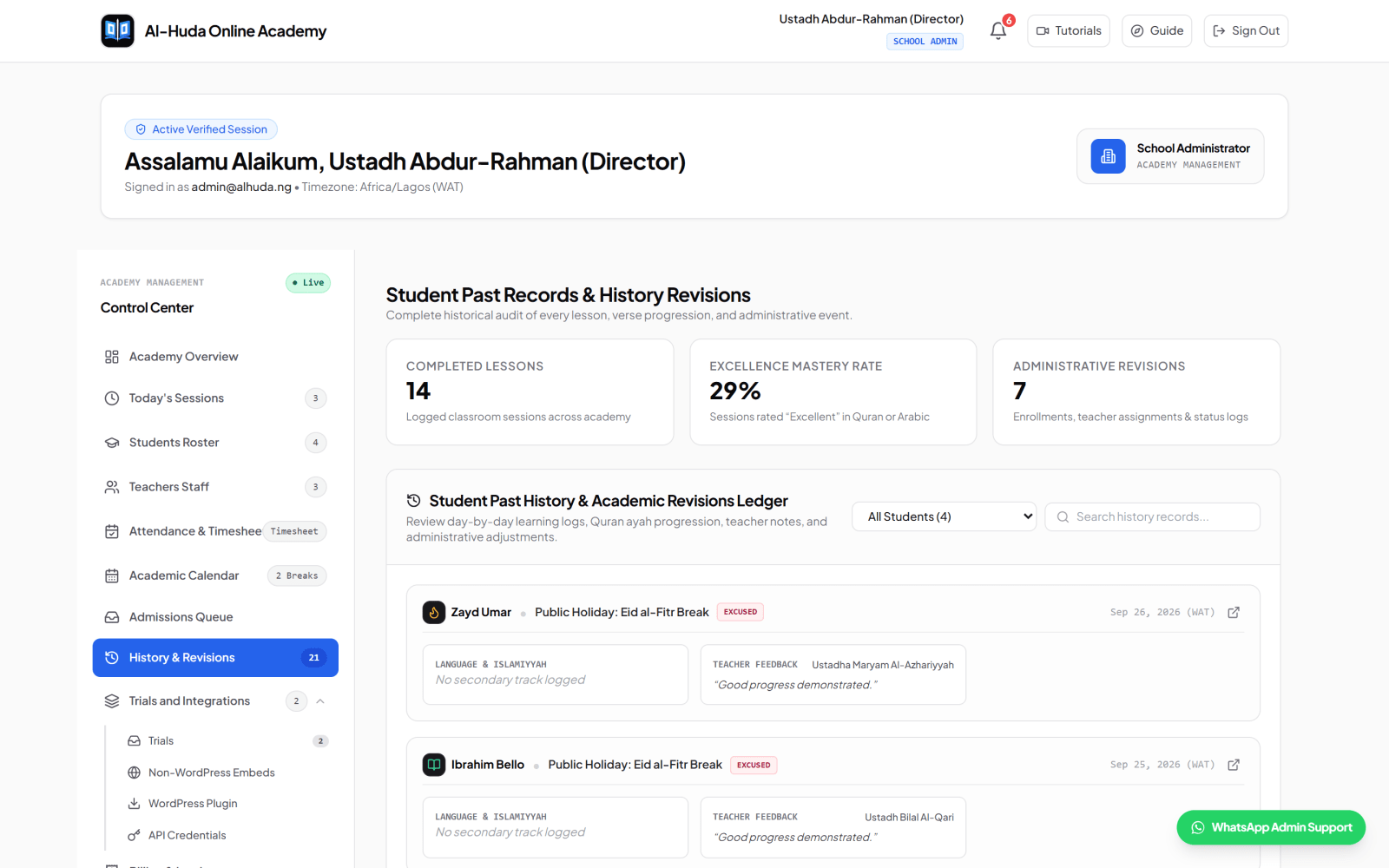
One difficult lesson may reflect tiredness, illness, unfamiliar material or a temporary disruption. One excellent lesson may not prove stable mastery. Review several records before changing a learner's plan, and note the evidence behind the decision.
Keep the history intact when a teacher changes. The incoming teacher should see the most recent verified location, quality judgment, recurring focus and next instruction. A handover summary may be helpful, but it should link back to the underlying lesson evidence.
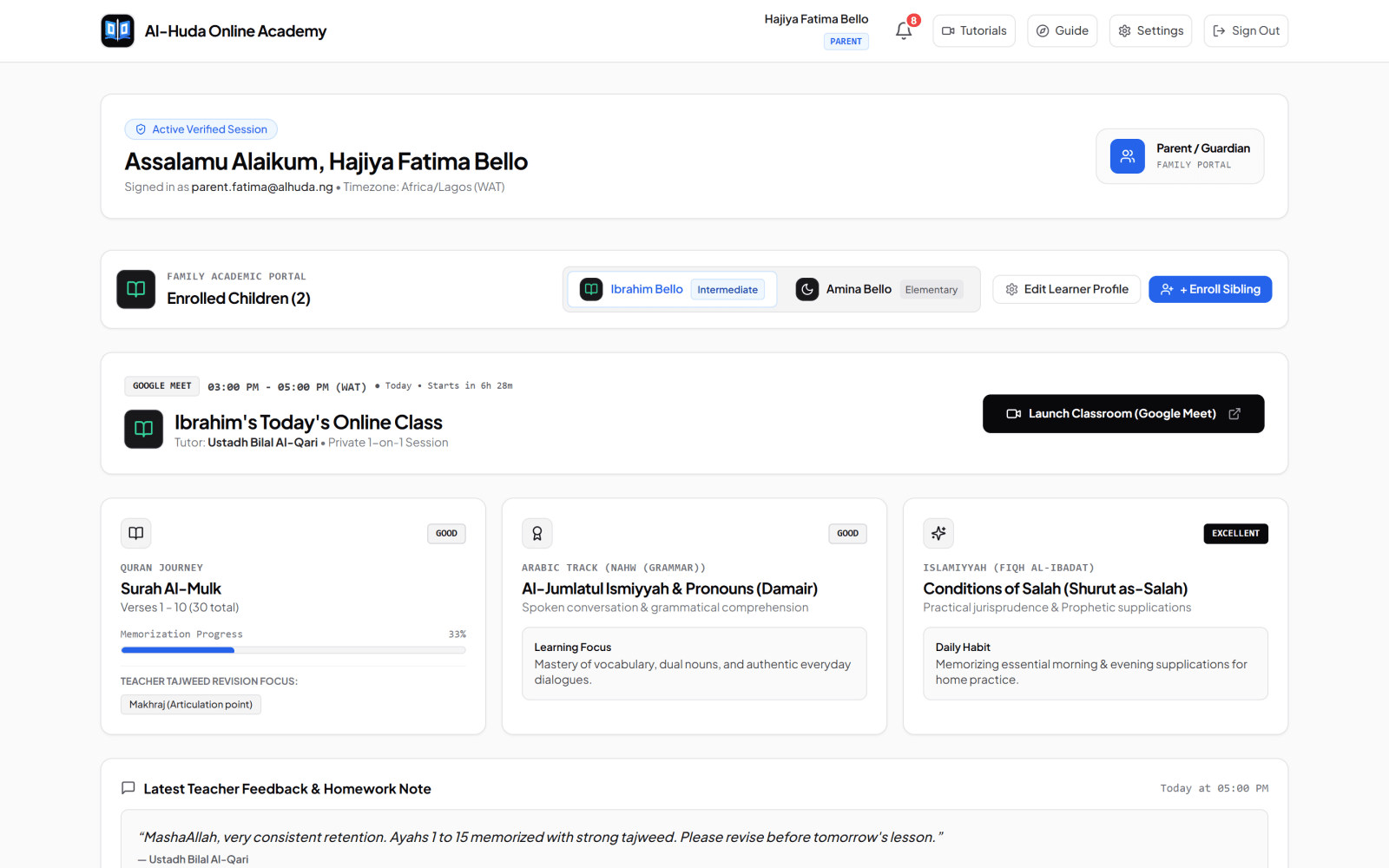
Parents and guardians usually need a clear explanation, not a raw export of every field. Translate the academic record into four parts: what was covered, what went well, what needs attention and what the learner should practise next.
Avoid vague praise, unexplained technical labels and percentages that imply more certainty than the record supports. If you show a progress bar within one Surah, label it as position within that Surah—not total Quran mastery or completion.
| Record element | Teacher evidence | Family-facing wording |
| Position | Surah Al-Mulk, Ayahs 1-10 | Amina worked on Ayahs 1-10 of Surah Al-Mulk |
| Quality | Good | She recited the assigned portion well with a few corrections |
| Focus | Madd and Makhraj | Please focus on elongation and clear articulation in the marked words |
| Next action | Revise the same range | Revise Ayahs 1-10 before the next lesson |
The fictional example is concise but traceable to the lesson record. A family can support the next action, while the academy retains the more precise academic terms for authorised review.
Progress reports become unreliable when records are missing, duplicated, backfilled without explanation or written under the wrong learner. Build lightweight controls around the teaching workflow.
Role separation matters. Directors may need academy-wide academic review, teachers need assigned learner context, and parents or adult learners should see only the records linked to them. A convenient global view is not acceptable if it weakens learner privacy.
List each programme, its objective and the minimum evidence required after a lesson. Have the Quran academic lead approve the rating descriptors, Tajweed categories and revision terminology. Decide what parents will see and what remains an internal note.
Create a short lesson form and a family-facing summary format. Test them with fictional Qaida, Tilawah, Hifdh, Arabic and Islamic Studies cases. Confirm that the form can represent an absent learner, a revision-only lesson and a teacher handover without inventing data.
Train a small group of teachers, then compare how they rate the same sample cases. Observe how long a genuine lesson entry takes and remove fields that do not support a decision. Check that parents understand the resulting summaries.
Audit missing records, inconsistent ratings and unclear next actions. Run a short academic review using the accumulated history. Correct the rubric and instructions before expanding to the full academy.
In the current Al-Ibiewi LMS lesson workflow, an authorised teacher or school administrator can record learner attendance and add Quran, Arabic or Islamic Studies evidence for a class. A Quran entry supports a Surah and Ayah range, one of four performance ratings, selected Tajweed focus tags and teacher feedback.
Saved lesson evidence contributes to the learner's current academic view and historical session timeline. Directors can inspect session history alongside relevant schedule and status changes. An authorised parent or independent adult learner can view linked progress, feedback and lesson history through the appropriate portal.
The system preserves the teacher's structured observation; it does not automatically assess recitation, diagnose Tajweed, design a curriculum or guarantee retention. It does not currently provide dedicated Sabaq, Sabqi and Manzil fields or automatic revision planning. Academies remain responsible for the teaching method, rubric, review and parent communication policy.
See the current teacher and parent flows in the Al-Ibiewi tutorials, apply for an academy account if the workflow fits your programme, or contact the team with a specific progress-recording question.
Use the reference that matches the programme and Mushaf convention, but preserve enough detail for the next teacher to locate the work. Surah and Ayah references are widely understandable; page references may depend on the Mushaf edition. State the convention when it could be ambiguous.
A percentage can describe a defined position, such as the Ayah reached within one Surah. It should not be presented as mastery, retention or total programme completion unless the calculation and academic meaning are explicitly defined.
Write enough to guide the next lesson and home practice: one clear strength, the main focus and the next action are often more useful than a long generic comment. Use a private academic conversation for complex or sensitive concerns.
Software can organise records and, where a verified feature exists, help surface prior work. The academy's qualified teacher remains responsible for interpreting performance and choosing an appropriate next task. Al-Ibiewi does not currently claim automatic revision planning.
Begin with missing or orphaned evidence: held lessons without logs, records without a next action, repeated needs-revision judgments without follow-up, and learners whose latest plan does not reflect their recent history.
A strong Quran progress system lets an authorised person understand where the learner worked, how the teacher assessed it, which concerns are recurring and what should happen next. When teachers record that evidence consistently, academic leaders can review patterns and families can support the learner without guessing.
Review how teachers record Quran learning and how authorised learners and families see the resulting history in Al-Ibiewi LMS.
Keep reading

Use this practical checklist to prepare academy records, configure workflows, test access, train staff and make an evidence-based decision before going live.

A practical guide for Nigerian Quran schools comparing scheduling, lesson records, parent access, fees, privacy, migration and support before choosing management software.

Bilingual monthly progress reports, academy report cards and parent fee collection are now included in every Al-Ibiewi LMS academy's price, with no separate add-on and no second invoice.