
How to Manage an Online Quran Academy
A practical operating system for managing enquiries, trials, enrolment, teacher assignment, schedules, attendance, lesson records, family communication and monthly review.
Ten steps to start an online Quran academy: who you teach, class format, time zones, teachers, prices, one class link per teacher, written rules, lesson records, your first learners and the first month.
Starting an online Quran academy costs less than renting a madrasah, but it takes more planning than most teachers expect. The teaching is the part you already know. What decides whether the academy lasts is everything around it: who you teach, when, for how much, and how families see that their child is learning.
This guide is for a teacher or a small team starting from nothing, in Nigeria or anywhere else. It goes through the ten steps in the order they come up. Once the academy is running, our guide on how to manage an online Quran academy picks up from there.
Before anything else, write one sentence that describes your academy. For example: "One-to-one Quran lessons for children aged 6 to 14, from Qaida to Hifz, with sisters teaching girls and brothers teaching boys." Every later choice, from teachers to prices, follows from that sentence.
One-to-one classes are the easiest place to start. Each learner moves at their own pace, and a missed class affects only one family. Group classes cost families less per lesson and suit learners who are at the same stage, such as a beginners' Qaida class or an Islamic Studies class. Hifz is usually taught one-to-one, because each learner is at a different place in the Quran.
Settle three numbers for each programme: minutes per lesson, lessons per week and learners per group. For young children, short and frequent lessons work better than one long lesson a week. Write the numbers down: they become your timetable and your price list.
Online classes cross borders. Nigeria is on West Africa Time (UTC+1) all year. The United Kingdom, Europe and North America move their clocks forward in spring and back in autumn, on different weekends, so the gap between a teacher in Kano and a learner in London or Toronto changes during the year. The Gulf states do not change their clocks.
Your teachers are your academy. Families stay with a teacher they trust, and they leave when lessons start late or the teacher keeps changing. Before anyone teaches, check four things:
Agree the pay before the first class: an amount per lesson taught, or a monthly amount. Paying per lesson is simpler at the start, but it needs an honest record of which lessons happened. That is one reason the lesson record in Step 8 matters.
Most online academies charge a monthly fee per learner, set by the number of lessons per week. Work the price out from your costs, not from the cheapest academy you can find: teacher pay, internet, the tools you use and your own time. A price you can keep for a year is better than a low price you have to raise after three months.
In Nigeria you can register a business name with the Corporate Affairs Commission (CAC), and banks ask for the registration before they open a business account. In other countries, check the local rules for a small tuition business. A registered name on the invoice and the account also helps families trust an academy they have only met online.
You can teach on Google Meet, Zoom or Microsoft Teams. Whichever you choose, give each teacher one fixed meeting link and use it for every class that teacher teaches. Families save it, and nobody has to search WhatsApp for today's link five minutes before class.
Before you build a timetable on a meeting tool, check what its free plan allows, such as a time limit on each meeting.
Families ask the same questions again and again. Answer them once, in a one-page handbook you send with every admission:
Decide what a teacher writes after each lesson before the first learner starts. It takes a minute, and it is what makes an academy more than a group of private tutors. For a Quran lesson:
With that record a family can see progress without messaging the teacher, you can pay teachers for the lessons that really happened, and the monthly report almost writes itself. A spreadsheet is enough for the first few learners. Our guides to Quran progress tracking and the session and attendance audit template show the columns to use.
Your first learners will come from people who already know you: your masjid, the families you teach now, relatives and friends abroad, and your WhatsApp status. Ask every happy family to tell one other family.
Our guide to admissions and trial booking covers the steps from enquiry to first class.
Start with the number of learners you and your teachers can serve well, even if that is five. At the end of the first month, look at the record:
Fix what the month shows, then take more learners. From there, our guide on how to manage an online Quran academy covers the daily, weekly and monthly routine.
| Area | Ready when |
|---|---|
| Academy | You can say who you teach in one sentence |
| Programmes | Each has minutes per lesson, lessons per week and group size |
| Timetable | Each class has a time for the teacher and for the family |
| Teachers | Each one passed a recitation check and a demo lesson |
| Price | A monthly fee per programme, due before the month |
| Money | A business bank account, invoices and receipts |
| Class link | Each teacher has one fixed meeting link |
| Rules | A one-page handbook for families |
| Records | A lesson record and attendance sheet a teacher can fill in on a phone |
| Enquiries | A list of every enquiry and its next step |
You can start with WhatsApp and a spreadsheet. The time to move to software is when the spreadsheet stops matching what happens: a teacher forgets to record lessons, a family asks for a report, or nobody is sure who has paid. Fusuli (formerly Al-Ibiewi LMS) is school management software for Islamic schools, and it keeps the steps above in one place:
It costs ₦500 per learner a month, with no minimum and never more than ₦50,000 a month, and a learner is billed only after their first 5 days. Academies abroad pay the same price by card. There is no free trial, and you do not need one: we set your academy up for you, free. Send us your list of teachers and learners on WhatsApp and we register them. Read more about Quran academy management software, or get started.
Less than a physical madrasah, because there is no building to rent. The main costs are teacher pay, internet or data, a meeting tool (many have free plans with limits), registering the business, and the software you run it on. Teacher pay is usually the largest, so set your prices from it.
Opening an academy does not depend on one, but the teaching must be sound. Families, especially for Hifz and Tajweed, often ask whether a teacher holds an ijazah and from whom they learnt. Be honest about what each teacher holds, and have every teacher's recitation checked by you or a qualified reciter.
One paying learner is enough to begin, if the fee covers the teacher. It is better to start with a few learners and serve them well than to take many and miss classes.
Yes. Plan the timetable around their time zone and its clock changes, take payment by card, and name the currency on every invoice.
One-to-one is easier to run at the start, and it suits Hifz. Add groups when you have several learners at the same level who can come at the same time, such as a beginners' Qaida class.
Explore the purpose-built academy system, then review the real role-based walkthroughs before deciding whether it fits your school.
Keep reading

A practical operating system for managing enquiries, trials, enrolment, teacher assignment, schedules, attendance, lesson records, family communication and monthly review.
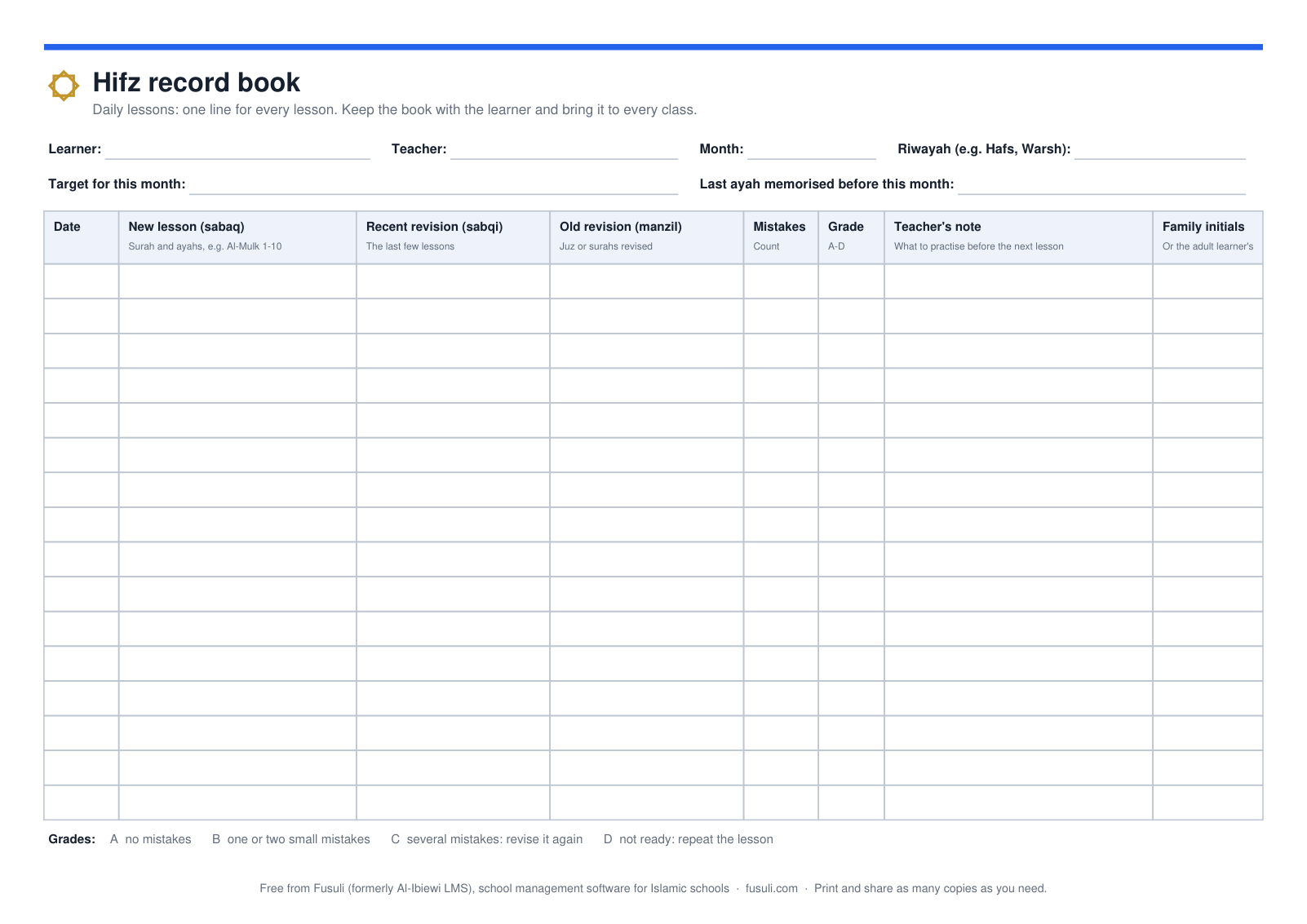
A free two-page hifz record book to print: a daily page for sabaq, sabqi and manzil with mistakes, a grade and a note for the family, and a page to follow all 30 juz. With a simple routine for teachers.
Download a practical Quran academy attendance and session-audit template that separates learner status, teacher presence, class outcomes, lesson evidence and follow-up.